I transform complex, fragmented systems — from datasets, processes, and workflows to departments and entire organizations — into clear, logical, integrated structures that reduce waste, improve communication and decision-making, and strengthen organizational effectiveness.
Throughout my career, I've applied this same approach across Data Management, Business Intelligence, Operations, Process Improvement, and Knowledge Management—working with systems of increasing scale and complexity while continually refining my methodology.
I thrive in organizations with a clear vision, mission, values, and goals—where effective leadership empowers creative problem-solving, continuous improvement, and ethical decision-making in alignment with these organizational North Stars.
My work is particularly valuable to growing businesses seeking to establish the systems and structures needed to scale—holding the center while others focus on growth—and established organizations looking to overcome stagnation, reduce complexity, and remain agile, innovative, and competitive.
My work is particularly valuable to growing businesses seeking to establish the systems and structures needed to scale, and established organizations looking to overcome stagnation, reduce complexity, and remain agile, innovative, and competitive.
If you've got a system that needs wrangling or a center that needs holding, I'm your man!
A Pacific Northwest near-native, I grew up in Southwest Washington—on the mountain, at the coast, or in the Gorge—where I find myself once again today.
Fueled by my love of family, copious amounts of coffee, and an insatiable curiosity about how the world works.
Father of daughters. Runner of trails. Curler. Unabashed Jim Henson fan. Convinced all the secrets to life are hidden in Ani DiFranco songs.
I'm an intrinsically driven person, and much of my life has been shaped by two seemingly opposing impulses: a drive toward logic, order, simplicity, and efficiency, and an equally powerful drive toward creative exploration.
For years, I pursued these impulses separately, until I realized they weren't diametrically opposed or mutually exclusiveat all, but instead complementary ways of approaching any project, problem, or puzzle.
Whether working with data, content, processes, or entire organizations, I'm naturally drawn to understand how things fit together—starting at the 10,000-foot level and progressively working inward to map the entities, relationships, and structures that make the whole system work.
For me, the joy lies in transforming complexity into clarity, finding elegant solutions to difficult problems, and organizing and communicating information in ways that are logical, concise, useful, and visually intuitive.
Early in my career, as a Data Warehouse Manager, this dual-perspective approach proved remarkably effective—allowing me to tackle meticulous, complex work with results that exceeded expectations and proved deeply rewarding.
My career subsequently took me through Business Intelligence, Brand Management, and Knowledge Management. While the titles changed, the underlying work remained remarkably consistent, and a pattern began to emerge: I was taking on systems of increasing scale and complexity, applying the same fundamental approach to understanding, restructuring, and improving them.
Along the way, what began as an instinctive way of thinking evolved into a deliberate, repeatable methodology—one that I've continued to refine with each new challenge.
I believe meaningful work happens when capable people unite around a clear vision and shared purpose, challenge one another's thinking, and collaborate toward something larger than themselves.
If that sounds like the kind of work you're doing, I'd love to connect!

At its core, my work is about understanding how systems function, identifying how they can function better, and making the changes necessary to get them there.
Whether building something from scratch or overhauling an existing system, I begin by understanding the whole—its purpose, components, relationships, and dependencies—and how effectively everything works together toward its intended objectives.
From there, I bring structure to complexity: eliminating inefficiencies, resolving inconsistencies, improving integration, and creating clear, logical, and sustainable ways of operating.
The result is a system that not only works better today, but can be understood, managed, and adapted as the needs and objectives of the organization evolve.
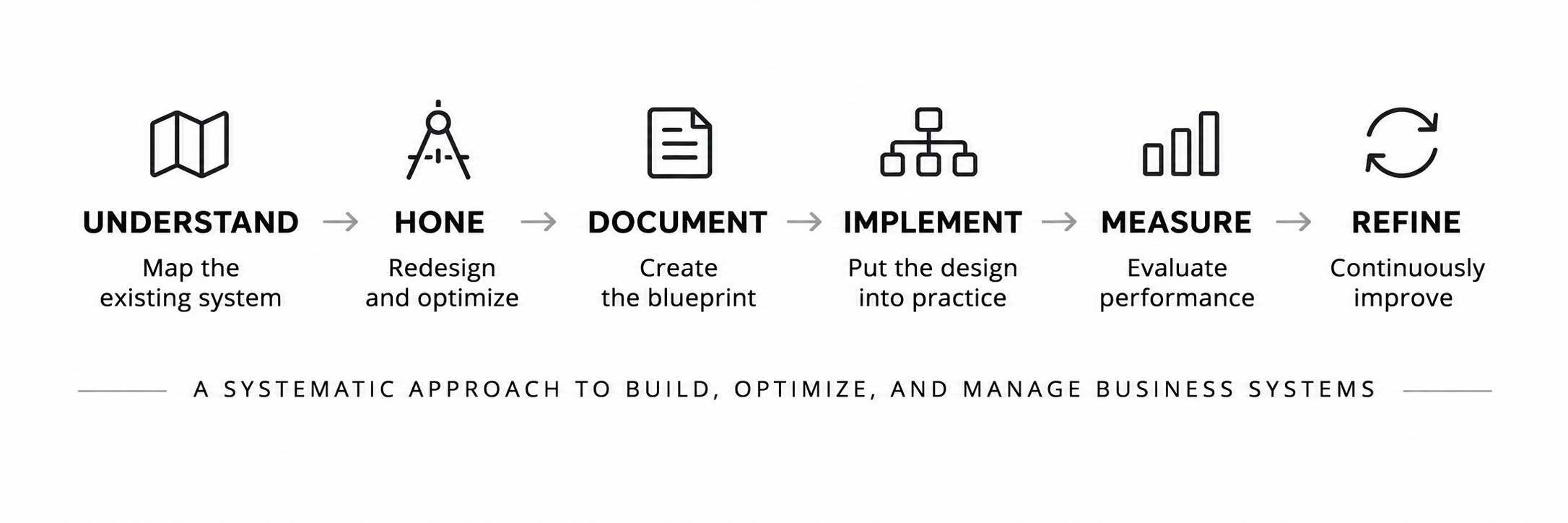








Whether the challenge involves building something new, improving what already exists, or helping an organization navigate growth and change, my focus remains the same: understanding the whole, improving how its parts work together, and creating systems that deliver meaningful, sustainable results.
Lorem ipsum dolor sit amet, consectetur adipiscing elit. Suspendisse varius enim in eros elementum tristique. Duis cursus, mi quis viverra ornare, eros dolor interdum nulla, ut commodo diam libero vitae erat. Aenean faucibus nibh et justo cursus id rutrum lorem imperdiet. Nunc ut sem vitae risus tristique posuere.
OCT 2012 - JAN 2013 -
JAN 2013 - MAY 2016 - Data Warehouse Manager (Iberdrola/Avangrid Renewables)
MAY 2016 - SEP 2019 - Business Intelligence Analyst (Skarberg Sales & Marketing)
SEP 2019 - JUN 2020 - Brand Manager (Cartograph)
JUN 2020 - FEB 2021 - COVID-19 Educational Project
FEB 2021 - NOV 2021 - Knowledge Manger (Cartograph)
Initially hired on as a contractor to build a comprehensive dataset from scratch, I spent months climbing around wind turbines and warehouses with a pen, notepad, computer, and camera, documenting the thousands of wind turbine and solar panel components required to maintain our vast fleet of equipment across the US.
Upon completion, the position of Data Warehouse Manager was created for me, where I was to manage this data set, oversee it's integration into our Global SAP Material Master for use across the globe, and to create a searchable Parts Catalog on our Microsoft SharePoint server to increase it's usability across multiple departments and stakeholders.

As the company’s first Business Intelligence Analyst, I was hired on specifically to dive into what was at the time the Wild West of Amazons vast, siloed data reporting aparatus inside the Amazon Vendor Central account portals for our larger clients — such as Sony, GE, PNY, & Marshall Speakers — and to both transform that data into actionalble intelligence as well as to create multiple reporting systems for convetying these insights both internally to my Brand Managers as well as directly to the clients.
Eventually my role expanded to include the management of these client's Amazon Digital Shelf - comprised of the content on their product page (Images, Bullets, Text, A+ Content), as well as the content on their Amazon Brand Store

Transitioning from Amazon-focused Business Intelligence into full Amazon Account Brand Management, I took responsibility not just for the data managementt, analysis, and reporting functions I had mastered and the content design and managemetn, but for all aspects of leading the business - including Strategy, Operations, Pricing, and Advertising.
Coming in a Brand Manager, I was immediate given ownership of our Justin's Nut Butter account, as I had the most experience in Vendor Central of any Brand Manager in the company coming in.
I also funcitoned as the sole Brand Specialist support to my assigned Brand Manager for her handfull of Amazon Seller Central clients as I got up to speed on running clients accounts through that portal (the portal for 3P sellers)

When COVID-19 disrupted my daughters' education, I took responsibility for developing and managing their learning experience.
What began as a family necessity evolved into an educational information-management project involving curriculum organization, website development, content architecture, and the design of intuitive learning systems.
When COVID closed my daughters’ elementary school, I stepped away from my career to focus on them. Frustrated by the fragmented remote-learning experience, I found the school’s underlying curriculum framework and built each daughter a website that reorganized it into clear learning paths—combining required coursework with carefully selected resources, individualized instruction, and my own assessments.
What began as a deeply personal decision became a professional revelation: the work I loved wasn’t specific to data, Amazon, or even business. It was taking a complex system, understanding its underlying structure and purpose, and reorganizing its information, tools, and processes so the people within it could navigate it more successfully. That realization led directly to my next role in Knowledge Management.

Returning to Cartograph during a period of rapid growth, I took responsibility for developing the company's knowledge-management and employee-training systems.
I worked to transform fragmented institutional knowledge into organized, accessible, and sustainable resources—helping employees find the information they needed while improving onboarding, training, and cross-departmental communication.
Returned to Cartograph to build and manage the knowledge and training systems of a rapidly scaling startup—creating the architecture for how organizational knowledge was captured, clarified, taught, shared, and continually improved. I built the Knowledge Base and training curriculum while leading Expert Committees that turned the collective experience of our Brand Managers into reusable organizational intelligence.
Knowledge Management brought the previous chapters of my career together: systems, information, communication, learning, and leadership. More importantly, it expanded my perspective from improving individual business systems to thinking about how an organization understands itself—and how that understanding allows its people to operate, learn, and adapt more intelligently.

There isn't yet one universally recognized job called “the thing Jarvis does.” Instead, I'm seeing your capabilities converging across several increasingly overlapping areas:
Co-Founder
Bivouac Racing is a Portland-area trail running events company I co-founded in 2019.
We established Bivouac Racing after inheriting a small but established series of four trail races in Oregon: Race to the Cape at Cape Lookout, Silver Falls Trail Challenge, Stub Stewart Trail Challenge, and Battle to the Pacific in Fort Stevens State Park.
Today, in addition this trail series, Bivouac Racing also puts on the Hellz Bellz Ultra 50-mile endurance race and the Crown Stub 100.
This venture allowed me to sate my entrepreneurial muse, collaborate and co-create with a team possessing symbiotic interests and skill sets, and apply my creativity to event development, website design, branding, and merchandise production.
Co-Founder
In 2006, leveraging my journalism studies and freelance experience, I co-founded The Vancouver Voice , an alternative newspaper in Vancouver, Washington.
This venture aimed to fill the void left by the city's previous alternative publication, The Vanguard, and foster a community among local businesses, artists, and artisans - whom I consider the bedrock of culture and quality of life in SW Washington.
It provided me with a platform to write freely, hone my photography skills, and engage deeply and regularly with this community.